

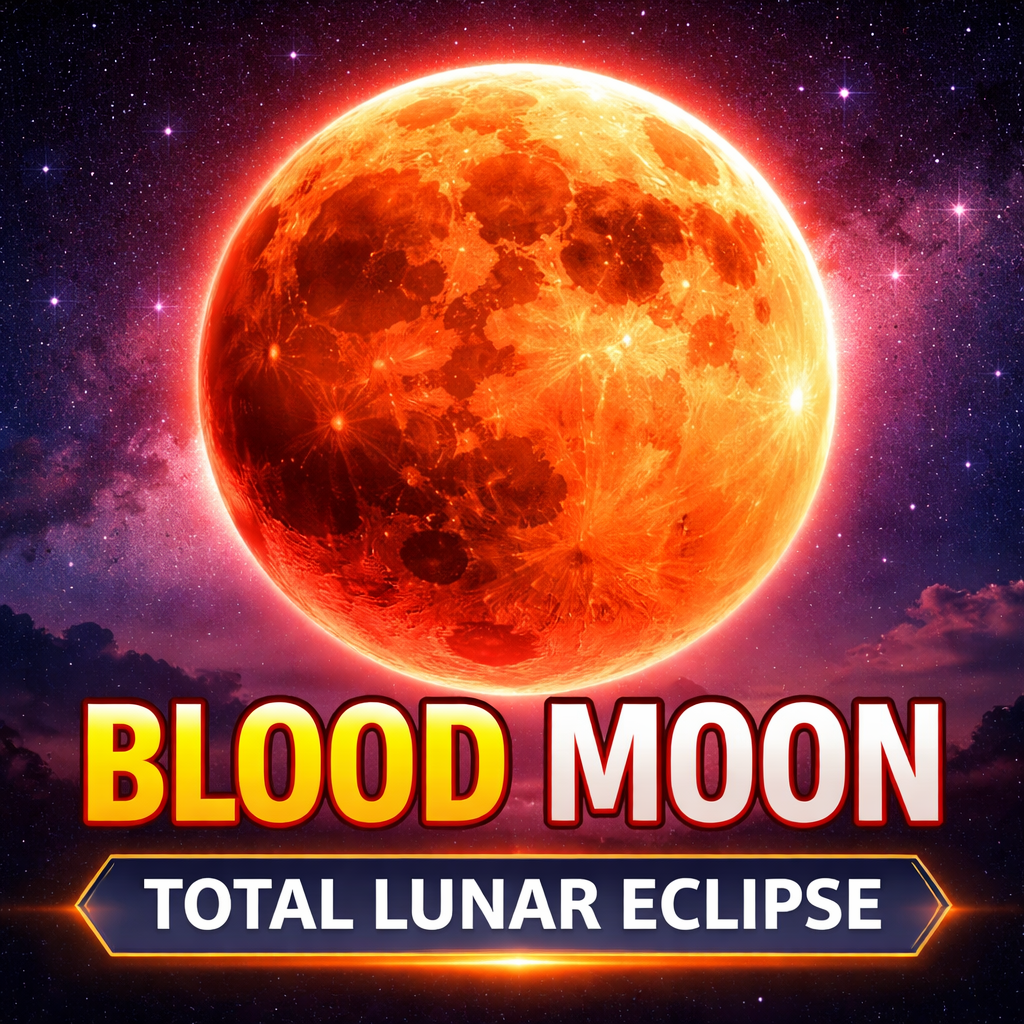
Skywatchers around much of the world are preparing for a breathtaking celestial show on Tuesday, March 3, 2026, when the full Moon will travel through Earth’s shadow and briefly turn a deep reddish hue, a phenomenon often called a “blood moon.”
Top 10 Home Security Must-Haves for Peace of Mind in 2026

This dramatic total lunar eclipse happens as the Earth lines up directly between the Sun and the Moon. When that occurs, sunlight passing through Earth’s atmosphere bends into the shadowed lunar surface, filtering out blue light and leaving the Moon with a glowing copper‑red tone that observers adore.
When It Happens
The eclipse unfolds in stages over several hours, but the most striking phase totality, when the Moon is fully inside Earth’s darkest shadow has a well‑defined window:
- Totality begins: 6:04 a.m. EST on March 3 (11:04 GMT)
- Peak of the eclipse: around 6:33 a.m. EST (11:33 GMT)
- Totality ends: about 7:02 a.m. EST (12:02 GMT)
Altogether, the Moon remains fully eclipsed for about 58 minutes.

Before and after totality, the Moon gradually enters and exits Earth’s outer shadow (penumbra and partial eclipse phases), so the full event from subtle shading to final penumbral exit stretches over roughly 5 hours and 39 minutes.
Where You Can See It
Because lunar eclipses occur simultaneously for all observers on the night side of Earth, the blood moon will be visible from many regions, including:
- Western North America — the Moon will still be above the horizon during totality
- Australia and New Zealand — totality occurs late on March 3 local time
- East Asia and much of the Pacific — the eclipse will also be visible in the evening sky
- Other locations may see part of the event depending on local moonrise or moonset times.
Unlike solar eclipses, lunar eclipses are safe to watch with the naked eye, and no special eyewear is needed. Still, binoculars or a small telescope can enrich the experience by bringing out lunar surface details.
A Rare and Special Event
The March 3 eclipse is notable not just for its beauty but because it will be the last total lunar eclipse visible from Earth until late 2028–2029, meaning many observers won’t have another chance for nearly three years.

Whether you’re a seasoned stargazer or a curious newcomer to skywatching, this blood moon promises a memorable sight in the early morning sky.
[Earnixor]